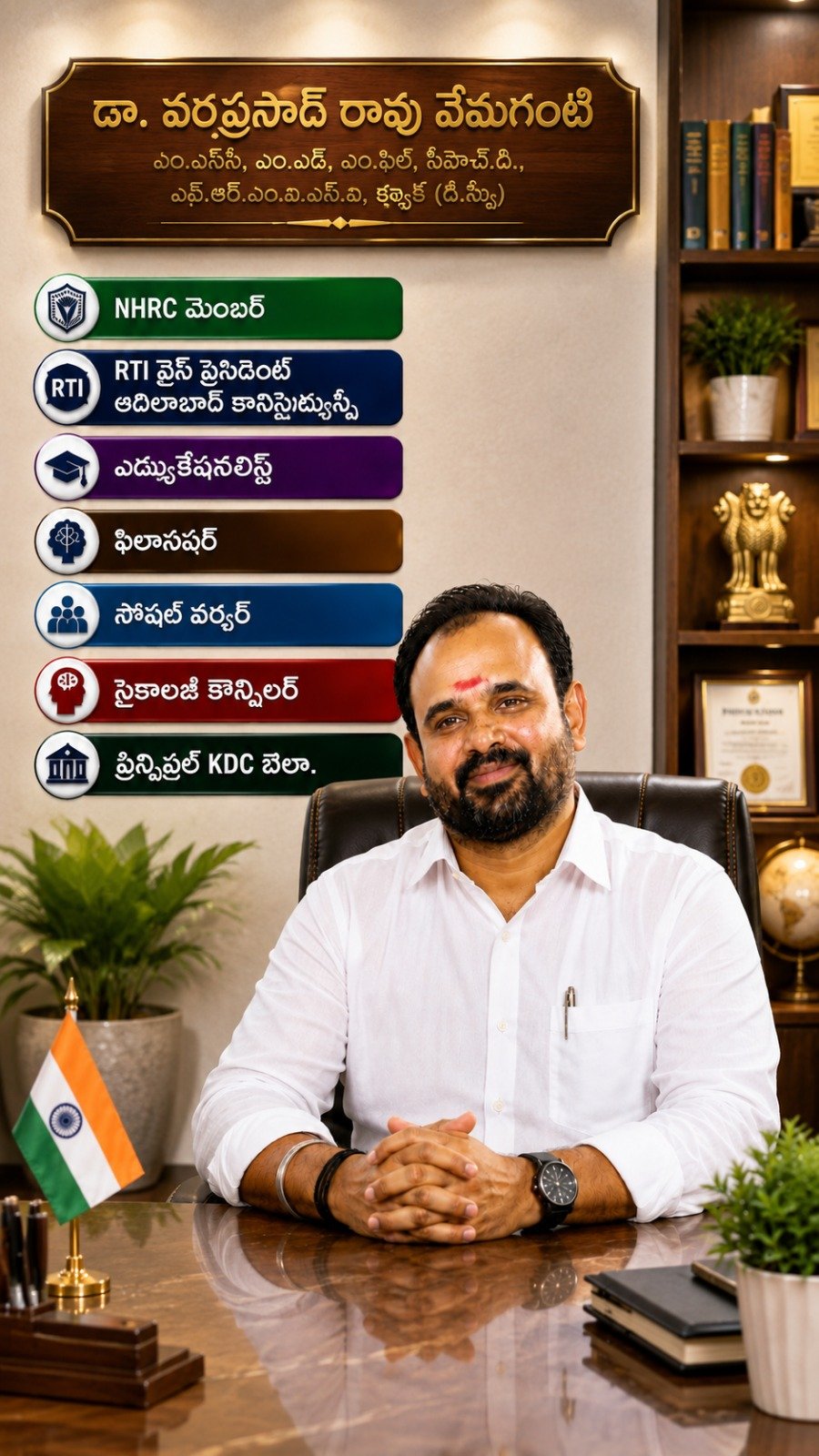
Dr. V. Varaprasad Rao: A Dedicated Botanist and Plant Taxonomist Advancing the Study of Flora, Biodiversity and Artificial Intelligence
From the Forests of Adilabad to the Frontiers of Modern Taxonomy, a Journey of Research, Education and Continuous Learning
In the world of science, some journeys are defined not by a single discovery, but by years of consistent research, teaching, writing and a willingness to keep learning. Dr. V. Varaprasad Rao is one such academic and researcher whose professional journey reflects a deep commitment to Botany, Plant Taxonomy, Floristic Diversity, Ethnobotany, Medicinal Plants and emerging applications of Artificial Intelligence in taxonomy.
Currently serving as Principal of Keerthana Degree College, Bela, Adilabad, under Kakatiya University, Warangal, Dr. Varaprasad Rao has developed an academic profile that connects classroom education with field-based botanical research. His work particularly focuses on the plant wealth of Telangana and the scientific understanding, documentation and conservation of plant diversity.
His journey also reflects a strong spirit of continuous education. Alongside his academic responsibilities, he is associated with Central Christian University (CCU), Malawi, South Africa, in online mode, and is pursuing research/course work for a D.Sc. (Doctorate in Science) at Euro Asian University, Tallinn, Estonia, with work related to Taxonomy with Artificial Intelligence.
A Career Rooted in Botany and Education
Dr. V. Varaprasad Rao's professional life has been closely connected with education and plant sciences. As the Principal of Keerthana Degree College, he contributes to the academic development of students while continuing his own research activities.
For him, education and research are closely connected. Teaching provides an opportunity to share scientific knowledge with younger generations, while research creates new opportunities to understand the natural world.
His academic interests have expanded across several important areas of Botany, including plant taxonomy, medicinal plants, ethnobotany, floristic composition, biodiversity, invasive species and plant nomenclature.
Exploring the Rich Plant Diversity of Adilabad
A significant part of Dr. Varaprasad Rao's research has focused on the Utnoor Forest and Adilabad region of Telangana.
His research papers examine subjects such as exotic flora, floristic diversity, invasive species, ethnomedicinal plants and traditional knowledge of medicinal plants.
Among his notable research works are “Exploring the Exotic Flora of Utnoor Forest, Adilabad District, Telangana,” “Study of Floristic Diversity and the Impact of Invasive Species in Utnoor Forest Telangana,” and “Conservation of Ethnomedicinal Plants from Utnoor Forest, Adilabad, Telangana, India.”
His research has also explored the traditional use of medicinal plants through studies such as “Traditional Knowledge and Usage of Medicinal Plants in Utnoor Forest Adilabad Telangana India” and “Ethnobotanical Survey of Medicinal Flora in Utnoor Forest, Telangana: Implications for Conservation and Healthcare.”
These areas of research highlight the importance of documenting plant resources and traditional knowledge while considering their relevance to conservation and healthcare.
Connecting Traditional Knowledge with Scientific Research
Plants have been part of Indian culture and traditional knowledge systems for centuries. Dr. Varaprasad Rao's research reflects an interest in understanding this relationship through an academic and scientific perspective.
His work includes studies on sacred plants and trees, including “Sacred Trees in Hindu Texts: A Scientific Review of Ecological Benefits Described in the Skanda Purana” and “Studies on the Use of Sacred Plants with Special Reference to Ganapathi Pooja.”
He has also worked on research examining indigenous plant species traditionally utilised for purposes related to infertility and sexual vitality, further demonstrating the breadth of his interest in ethnobotany and traditional plant knowledge.
Through such research, his work brings together elements of culture, traditional knowledge, ecology and botanical science.
Research Beyond the Forest
Dr. Varaprasad Rao's research interests are not restricted to a single geographical region or subject.
His research paper “A Comprehensive Study of the Impact of Conocarpus Plants on Urban Ecosystems, Biodiversity, and Resource Management” examines the relationship between plant species and urban ecological systems.
He has also written on jasmine flowers and their role in stress relief, along with the advantages and disadvantages associated with jasmine plants.
These studies demonstrate his broader interest in understanding how plants interact with human life, ecosystems and environmental management.
Modern Taxonomy and the Role of Artificial Intelligence
One of the most contemporary aspects of Dr. Varaprasad Rao's academic journey is his interest in the intersection of Artificial Intelligence and Plant Taxonomy.
His research includes “The Impact of Molecular Evidence on Plant Nomenclature: A Review of Recent Taxonomic Changes” and “Recent Changes in Plant Scientific Names and Families According to the ICN.”
In 2026, he also worked on “Artificial Intelligence in Taxonomy: Advancing Species Identification and Classification.”
This area represents an emerging direction in botanical research, where technological tools can potentially support the identification, classification and study of plant species.
His ongoing D.Sc. work in Taxonomy with Artificial Intelligence further reflects his interest in connecting traditional botanical knowledge with modern scientific technologies.
An Author with a Growing Body of Work
Alongside research papers, Dr. V. Varaprasad Rao has contributed to a range of books and academic works related to Botany and plant sciences.
His listed book titles include “Microbial Diversity and Early Land Plants,” “Botany Hand Book,” “A Text Book of Botany,” “Medicinal Plants List with Photos of Adilabad,” “Recent Modifications Changes in Plant Taxonomy,” “The Flora of Telangana,” “Floristic Composition and Species Diversity,” “Advantages and Disadvantages of Conocarpus Trees,” “The Floristic Composition and Species Biodiversity,” and “Medicinal Plants List.”
These works reflect his continuing effort to document and communicate botanical knowledge for students, researchers and readers interested in plant science.
A Researcher Who Continues to Learn
One of the notable features of Dr. Varaprasad Rao's career is his commitment to continuous academic development.
He holds a Ph.D. from the University of Swahili, North America, awarded in 2006, and another regular Ph.D. from SRTMUN, completed in 2021, according to the information provided.
His participation in more than 100 national and international conferences, through both online and offline modes, has also provided opportunities to engage with wider academic and research communities.
For an educator and researcher, such continuous engagement can help keep knowledge connected to new developments in science.
Recognition for Academic and Research Contributions
Dr. Varaprasad Rao's academic and professional journey has received several recognitions.
His listed honours include the Best Plant Taxonomist Award, INSC Awards, Education Research recognition, Mentor of Philosophy, Dr. A.P.J. Abdul Kalam Ratna Award, Dr. B.R. Ambedkar National Award and Bapu Seva Ratna Award.
These recognitions represent different dimensions of his work across plant taxonomy, education, research and academic mentorship.
A Vision for the Future of Plant Science
Dr. V. Varaprasad Rao's journey reflects an evolving vision for botanical science—one that respects traditional knowledge while embracing modern research methodologies and emerging technologies.
His continued work in plant taxonomy, medicinal plants, biodiversity conservation, ethnobotany and Artificial Intelligence-based species identification points towards a future where botanical research can become increasingly interdisciplinary.
For Telangana, particularly regions such as Adilabad that possess significant plant diversity and traditional knowledge, systematic documentation and scientific study can play an important role in understanding and preserving natural resources.
A Journey Driven by Curiosity and Knowledge
The story of Dr. V. Varaprasad Rao is ultimately a story of continuous curiosity.
From teaching and academic leadership to research on the forests of Adilabad, from medicinal plants and sacred trees to modern plant nomenclature, and from traditional botanical knowledge to Artificial Intelligence in Taxonomy, his work reflects a willingness to explore new questions while remaining connected to the fundamentals of Botany.
His journey demonstrates that the work of a researcher does not end with a degree or publication. It continues through every field study, every student guided, every research question explored and every new generation encouraged to understand the natural world.
Books Authored by Dr. V. Varaprasad Rao
Alongside his research papers and academic contributions, Dr. V. Varaprasad Rao has authored and contributed to several books and academic works covering Botany, Plant Taxonomy, Medicinal Plants, Floristic Diversity, Biodiversity and the Flora of Telangana. His listed books include:
-
Microbial Diversity and Early Land Plants
-
Botany Handbook
-
A Textbook of Botany
-
Medicinal Plants List with Photos of Adilabad
-
Recent Modifications and Changes in Plant Taxonomy
-
The Flora of Telangana
-
Floristic Composition and Species Diversity
-
Advantages and Disadvantages of Conocarpus Trees
-
The Floristic Composition and Species Biodiversity
-
Medicinal Plants List
These publications complement his research interests in plant science, taxonomy, biodiversity, medicinal plants and regional flora, and contribute to the documentation and dissemination of botanical knowledge among students, researchers and readers interested in the natural diversity of Telangana and India.
Dr. V. Varaprasad Rao's professional journey stands as an example of how education, research and lifelong learning can come together to deepen our understanding of plants, biodiversity and the scientific heritage of the natural world.